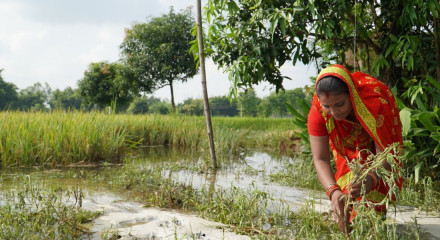

_1785150535.jpg) When Tulsi Bikal was pregnant, the nearest antenatal checkup was three hours away by car. Her local facility, Bhur Health Post in Bheri Municipality of Jajarkot, did not have the capacity she needed, so she travelled to Chaurjahari, in neighbouring Rukum West, on mountain roads that disasters regularly closed. Some months the journey happened. Some months it could not. And the health post she passed on her way out of the village had troubles of its own: last year it went without electricity for more than 1,000 hours, the equivalent of 41 days in the dark.
When Tulsi Bikal was pregnant, the nearest antenatal checkup was three hours away by car. Her local facility, Bhur Health Post in Bheri Municipality of Jajarkot, did not have the capacity she needed, so she travelled to Chaurjahari, in neighbouring Rukum West, on mountain roads that disasters regularly closed. Some months the journey happened. Some months it could not. And the health post she passed on her way out of the village had troubles of its own: last year it went without electricity for more than 1,000 hours, the equivalent of 41 days in the dark.
“Now I can receive antenatal checkups close to home, without worrying about long journeys,” Tulsi says. Her sentence carries more weight than it seems.
Nepal’s progress on maternal health is one of the great achievements of its generation: maternal deaths fell from 539 per 100,000 live births in 1996 to 142 in 2023. But the gain thins at the edges of the map, in the places where climate change presses hardest. That is where UNFPA, supported by the Government of Japan, went to work after the 2023 Jajarkot earthquake and the 2024 Rautahat floods, strengthening climate-resilient maternal and newborn care in the districts where floods, extreme heat, landslides and cold waves recur.
The method was patient: mapping the gaps, turning findings into costed local plans, refurbishing health facilities, and training Female Community Health Volunteers to respond to climate-related emergencies.
At Bhur Health Post, a renewable energy backup keeps the lights and equipment on when the grid fails. Insulated ceilings and proper heating and cooling hold the delivery and care rooms steady through cold waves and heat alike. And a Doppler device lets a health worker find what every anxious mother is listening for: the small, insistent heartbeat of a child on the way.
Mayor Chandra Prakash Gharti, reflecting on the municipality’s climate adaptation plan, said the local government would keep coordinating with health posts and provincial partners to sustain the improvements. The plan, in other words, has owners.
UNFPA is now supporting the Government of Nepal in carrying the model to other districts and provinces, with Bhur as one working proof. The work ahead is unglamorous and essential: keeping power systems maintained, plans funded and volunteers trained, so that the next earthquake or flood interrupts nothing a mother needs.
For Tulsi, checkups happen close to home now, at a facility open around the clock, emergencies included. The road to Chaurjahari is still long. But she no longer needs to walk it.
_1785150305.jpg) |
_1785150340.jpg) |
| Postnatal care room of Bhur Health Post before the refurbishment work. | Postnatal care room of Bhur Health Post after the refurbishment work. |
_1785150133.jpg) |
|
| Wind turbine at Bhagwati health post | |