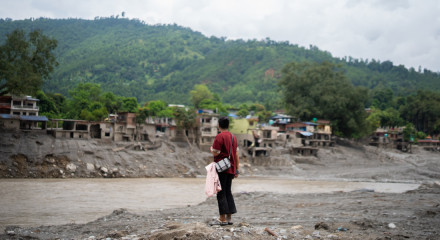

One month after the floods tore through Rasuwa, Nuwakot and Dhading, the UN in Nepal has kept response efforts fast, coordinated, and close to communities.
When the Bhote Koshi and Trishuli rivers surged on 26 August, the water took lives, homes, roads, bridges and livelihoods with it. Communities that had been only hours from Kathmandu that morning were cut off by nightfall.
Latest Government figures record over 1,451 people who have lost their lives and over 5,000 who remain missing. Thousands more lost homes, livelihoods and access to basic services. The scale of the destruction extends beyond the human toll, with 13 hydropower projects affected and major impacts on transport, trade and tourism, with the overall damage and losses estimated at around 4–5 per cent of Nepal’s GDP.

Amid that loss, the priority was coordination with the Government, including the National Disaster Risk Reduction and Management Authority (NDRRMA) and the Ministry of Home Affairs, followed by coordination with the UN, OCHA, IFRC, Member States and humanitarian partners. The Government established the response and coordination mechanisms, with the UN and partners coming in to support them.
One month on, here are six ways the Government, the UN, humanitarian partners and local authorities have worked together to reach more than 64,000 people through the UN's joint response.
1. Early coordination enabled early response
In the first hours, with roads gone, communications down and communities inaccessible, there was no complete picture of what had happened.
The Government led from the outset, with the National Disaster Risk Reduction and Management Authority (NDRRMA) and the Ministry of Home Affairs establishing the response mechanisms and priorities. UN Resident Coordinator Lila Pieters Yahia and UN humanitarian agencies worked in support, together with Emergency Relief Coordinator Tom Fletcher, OCHA, IFRC, Member States and other partners, meeting daily through the emergency phase.

Additional expertise followed, including an OCHA surge team and a United Nations Disaster Assessment and Coordination team. US$2.5 million was released through the UN Central Emergency Response Fund, alongside contributions from the United Kingdom, Norway and Australia through the Multi-Partner Trust Fund.

2. Delivering as one to ensure needs are met
When a family loses its home, it may need shelter, food, clean water, medical care, protection and schooling for its children, all at once.
The coordinated response brings together clusters covering health, food, shelter, water and sanitation, protection, education, nutrition, camp management, logistics, early recovery and coordination. WFP has supported logistics and food security; UNICEF, water, protection, education and child health; UNFPA, pregnant and lactating women, adolescents, psychosocial support and dignity kits; and WHO, primary health care, advice on DNA testing and managing human remains. Thanks to the Ministry of Health and Population, WHO, UNICEF and partners, no communicable disease outbreak has been reported.

Just over a week after the floods, the UN office in Bidur became a coordination hub near affected communities, helping the local government coordinate more than 100 NGOs and associations. With local authorities, the Nepal Red Cross Society and IOM, the team has identified temporary shelter options and tracked who has been reached and where gaps remain.
3. Coordination translated into things people needed
In the early days, communities asked for simple things: rice and lentils, drinking water, tents and solar batteries to light a room, charge a phone and reconnect with the outside world.
Over the past month, more than 30,000 people have received food assistance and more than 54,000 have been reached with water, sanitation and hygiene services. Families have received shelter materials and household items, while emergency medical care and safe spaces for women and children continue.

Psychosocial support has been especially important. People watched loved ones disappear under the flood wave, and many lost their breadwinners. Older people and working-age women have suddenly become heads of household while caring for traumatised family members, leaving little time for their own recovery.
4. When roads disappeared, the response found another way
Destroyed roads and bridges in Rasuwa, steep terrain and monsoon rains that could wash out routes without warning made delivering basic supplies a logistical challenge.

Helicopters carried food and relief supplies to more than 1,600 households cut off by road. Supplies moved through staging areas and forward hubs as partners tracked changing road conditions.

5. Local needs were carried to the international stage
The Resident Coordinator visited affected areas twice in the first ten days, meeting communities, local authorities, Government officials, security forces and humanitarian partners. What she heard, together with assessments on the ground, shaped the response and was carried to donors.
On 4 September, the Government and United Nations launched a US$49.6 million Flash Appeal to support more than 84,000 people across 17 municipalities under the overall leadership of the National Disaster Risk Reduction and Management Authority (NDRRMA). As of today, US$22 million has been pledged against the appeal, including through the Nepal Sustainable Development Cooperation Framework Fund, and efforts are accelerating to close the gap.

The response has also been a national effort. Across Nepal, people mobilized to support affected communities, with local communities, youth, the private sector and philanthropic organizations stepped forward alongside international partners, while people across the country and globally contributed in large numbers to the Prime Minister's Disaster Relief Fund.
6. Turning from response to recovery
A month later, families remain displaced. An estimated 2.2 million tonnes of debris still need to be cleared, safe land must be found for those unable to return home, and in upper Rasuwa, winter is approaching.
The next phase must connect relief with recovery: restoring services and livelihoods, reopening access and helping communities rebuild safer and more resilient. Longer-term reconstruction will be led by the Government and informed by its forthcoming Post-Disaster Needs Assessment.

The water has receded and the headlines have moved on, but for affected families, recovery is only beginning. The coordinated effort of the first weeks, under the Government's leadership, must now be sustained until families can move from surviving to rebuilding their lives.